

Clinical Resource Library
Your textbook was only the beginning.
The book teaches you what to see.
The library helps you decide what to do next.

You’ve read the concepts. You’ve worked through the clinical reasoning. Now it’s time to put Rehabilitation Through Function into practice.
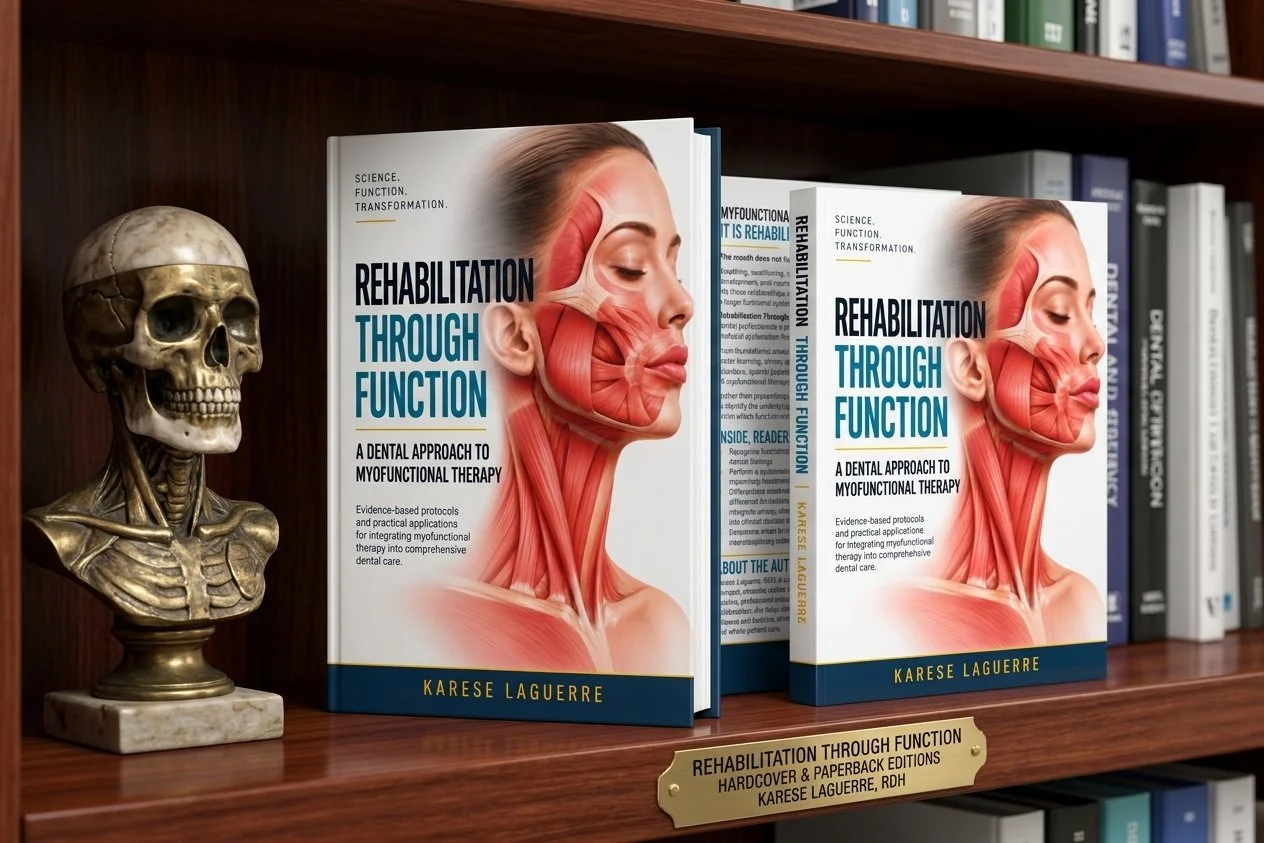
The Rehabilitation Through Function Clinical Resource Library is an exclusive collection of downloadable tools created to help hardcover readers translate the principles of the textbook into everyday clinical care.
From assessment and treatment planning to referral decisions, reassessment, patient education, and interdisciplinary communication, these resources are designed to help you move from:
“I see something…” to “I know what I need to investigate next.”
Exclusive access for hardcover readers
This library was created specifically as a companion to the hardcover edition of Rehabilitation Through Function: A Dental Approach to Myofunctional Therapy.
Why?
Because apparently writing an entire textbook was still not enough for me.
I believe education becomes most valuable when you can actually use it. I wanted to give you more than concepts to remember. I wanted to give you practical tools you could return to when a patient makes you pause, when a treatment plan feels complicated, or when you are trying to determine whether the next step is rehabilitation, structural intervention, reassessment, or referral.
The book teaches the framework. This library helps you work within it.
Access Your Clinical Resource Library
What You’ll Find Inside
The resource library will include a growing collection of practical clinical tools such as:
Clinical decision-making guides to help organize complex findings and determine appropriate next steps
Myofunctional deficit reference tools to distinguish mobility, strength, endurance, motor control, coordination, proprioception, and habituation concerns
Structure–Function–Symptoms worksheets to help separate what is visible from what is functionally meaningful
Referral guides to help identify when collaboration with ENT, orthodontics, sleep medicine, SLP, PT, OT, oral surgery, or another discipline may be appropriate
Clinical red-flag resources to help recognize when exercise or rehabilitation should stop and further evaluation should begin
Treatment-sequencing frameworks for common interdisciplinary presentations
Reassessment and progress-tracking tools to help determine whether therapy is producing meaningful functional change
Quick-reference clinical charts for use during evaluation, treatment planning, or patient education
Patient and provider communication resources designed to make complex functional concepts easier to explain
Additional tools and resources created to complement future clinical needs identified through the book
The goal is not to give you a rigid protocol. It is to make clinical reasoning easier to apply.
Frequently Asked Questions
Who can access the Clinical Resource Library?
1
The library is a companion resource created exclusively for owners of the hardcover edition of Rehabilitation Through Function: A Dental Approach to Myofunctional Therapy.
Are the resources a substitute for clinical training?
2
No. The resources are educational tools intended to support the concepts taught in the textbook. They do not replace professional education, diagnosis, clinical judgment, licensure requirements, or interdisciplinary care.
Can I use the resources in my practice?
3
Resources designated as clinical worksheets, patient education materials, or printable tools may be used according to the terms included with each resource. They may not be resold, republished, uploaded to other platforms, or distributed as standalone educational products.
Will more resources be added?
4
That is the plan. As additional tools are developed to complement the clinical frameworks in the Rehabilitation Through Function textbook, they may be added to the library for hardcover readers.
I have always believed that if I know something that can make someone else a better clinician, educator, parent, or advocate, I should share it.
That is part of why this textbook became as comprehensive as it did, and why this resource library exists.
I do not want Rehabilitation Through Function to be a book you finish. I want it to become a book you use.
I hope these resources help you ask better questions, recognize the difference between dysfunction and variation, make more thoughtful referrals, create more individualized treatment plans, and become increasingly comfortable saying both:
“I can help with this.” and “This needs someone else.”
Both are signs of excellent clinical care.
Thank you for allowing me to be part of the way you practice.
-Karese Laguerre